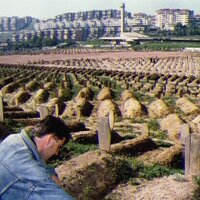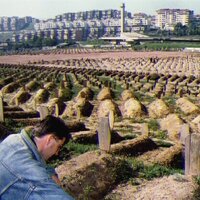


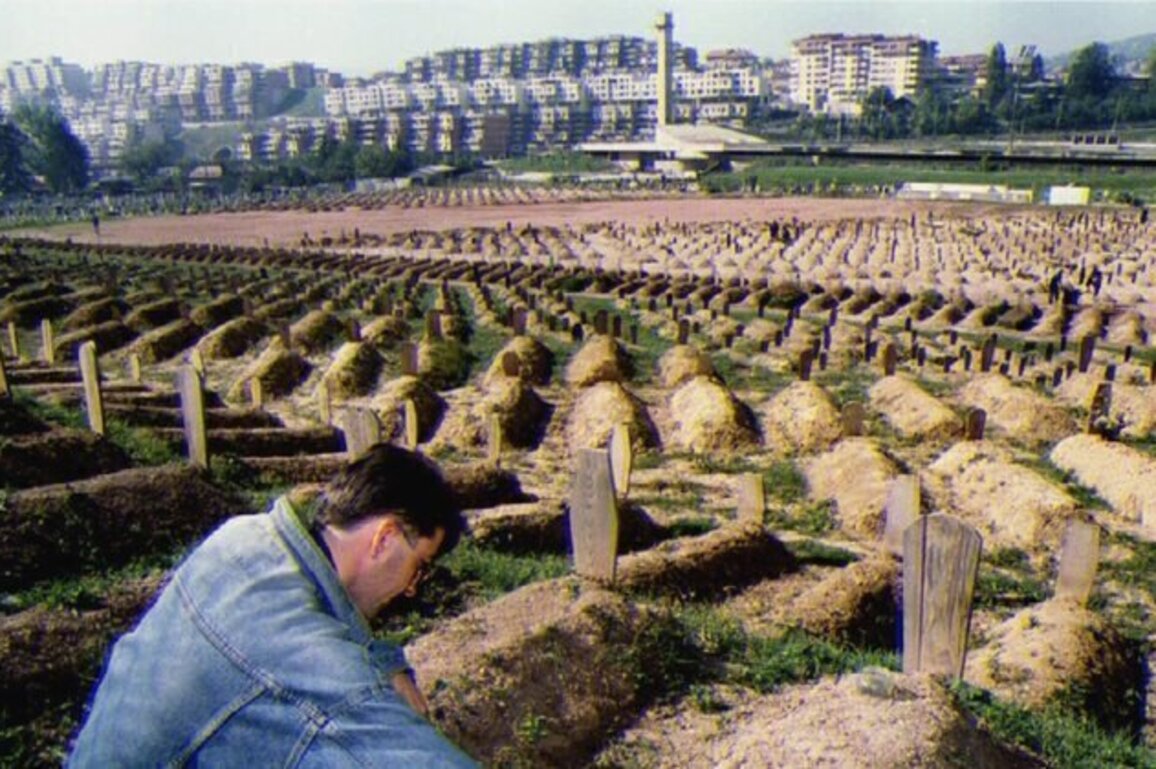
Irina Cesic celebrated her first birthday on October 8, 1993. Four days later, she waskilledby a snipers bullet on the streets of the Bosnian capital, Sarajevo.
"Since Irina had just learned to walk, my wife Stana was holding her by the hand," Irinas father, Samir Cesic, told RFE/RL. "We never understood why someone would shoot at a 5060-centimeter target -- the height of a one-year-old girl -- instead of a much larger one, like my wife, who would have been easier to hit."
For three decades, Irinas parents have sought an answer: Was their daughter killed simply to cause more pain and suffering? In recent days, their grief has been reignited by reports in the Italian media about an investigation being conducted in Milan into the so-called "weekend snipers."
According to the Italian newspapers Il Giorno and La Repubblica, and the news agency ANSA, prosecutors are investigating claims that during the 1992-1995 war in Bosnia-Herzegovina, wealthy foreigners paid "large sums of money" to shoot civilians in besieged Sarajevo -- "for fun."
The Milan prosecutors office did not respond to RFE/RL's inquiry regarding the current stage of the investigation or against whom it may have been initiated.
An Olympic City Under Sniper Fire
Sarajevo was surrounded by the Army of the Republika Srpska from 1992 to 1995. With a siege lasting 1,425 days, it was one of the longest sieges of a city in modern European history.
More than 1,600 children were killed, and 14,000 children were wounded.
Every 10th child killed in the city that had hosted the 1984 Olympic Games was hit by a sniper, according to data from victims associations and judgments by UN courts.
SEE ALSO:
Srebrenica Genocide Anniversary Highlights Justice Gaps and Global Implications
Despite this, not a single sniper has ever been held personally accountable -- neither before Bosnian nor international courts.
In verdicts against the highest officials of Republika Srpska, the UN International Criminal Tribunal for the Former Yugoslavia (ICTY) concluded that the sniper campaign had a single objective: "to terrorize the civilians."
Florence Hartmann, a former spokesperson for the ICTY prosecutors office, told RFE/RL that they "were aware" of so-called "death tourism expeditions."
"We knew about it. We didnt know how it was organized. It is extremely important that a judicial investigation has been launched and that those who organized it are identified," Hartmann told RFE/RL.
'Hunting In Sarajevo'
Benjamina Karic, mayor of Sarajevo's Centar municipality, was one year old when the war began. After watching the premiere of a documentary about the alleged killings, Sarajevo Safari, in 2022, she filed a criminal complaint with Bosnia's Prosecutor-General's Office and later with Italian authorities.
"That rich people came to Sarajevo on weekends to kill our children -- its the darkest thing one can imagine," Karic told RFE/RL.
She received no response until mid-2025. In August, through the Italian Embassy in Bosnia, she filed an additional criminal complaint with new information provided by Italian journalist Ezio Gavazzeni.
Gavazzeni took an interest in the case and contacted prosecutors in Milan with the help of former judge Guido Salvini, but neither he nor Salvini responded to RFE/RL's inquiry.
"Everything that has been happening lately gives a glimmer of hope that at least a fraction of justice will be served," Karic told RFE/RL.
In several ICTY verdicts, the UN court emphasized that the sniper campaign was designed to "terrorize civilians."
"Sarajevo civilians were targeted by snipers while going to fetch water. Snipers fired at children as they played in front of their homes, walked with their parents, returned from school, or rode their bicycles," said judge O-Gon Kwon,readingthe verdict against Radovan Karadzic, the wartime president of Republika Srpska, who was sentenced to life imprisonment in 2019.